Decentralized finance, commonly known as DeFi, has changed how cryptocurrency users think about saving, lending, borrowing, and earning returns on digital assets. Instead of relying exclusively on banks or centralized financial institutions, DeFi platforms use blockchain networks and smart contracts to provide financial services directly to users.
Sky Money, commonly presented through sky.money, is part of this evolving DeFi landscape. It provides access to products built around the Sky ecosystem, with a strong focus on stablecoins, savings, staking, and yield-generating strategies. The platform is closely connected to the broader Sky protocol, the ecosystem that evolved from MakerDAO and its DAI stablecoin system.
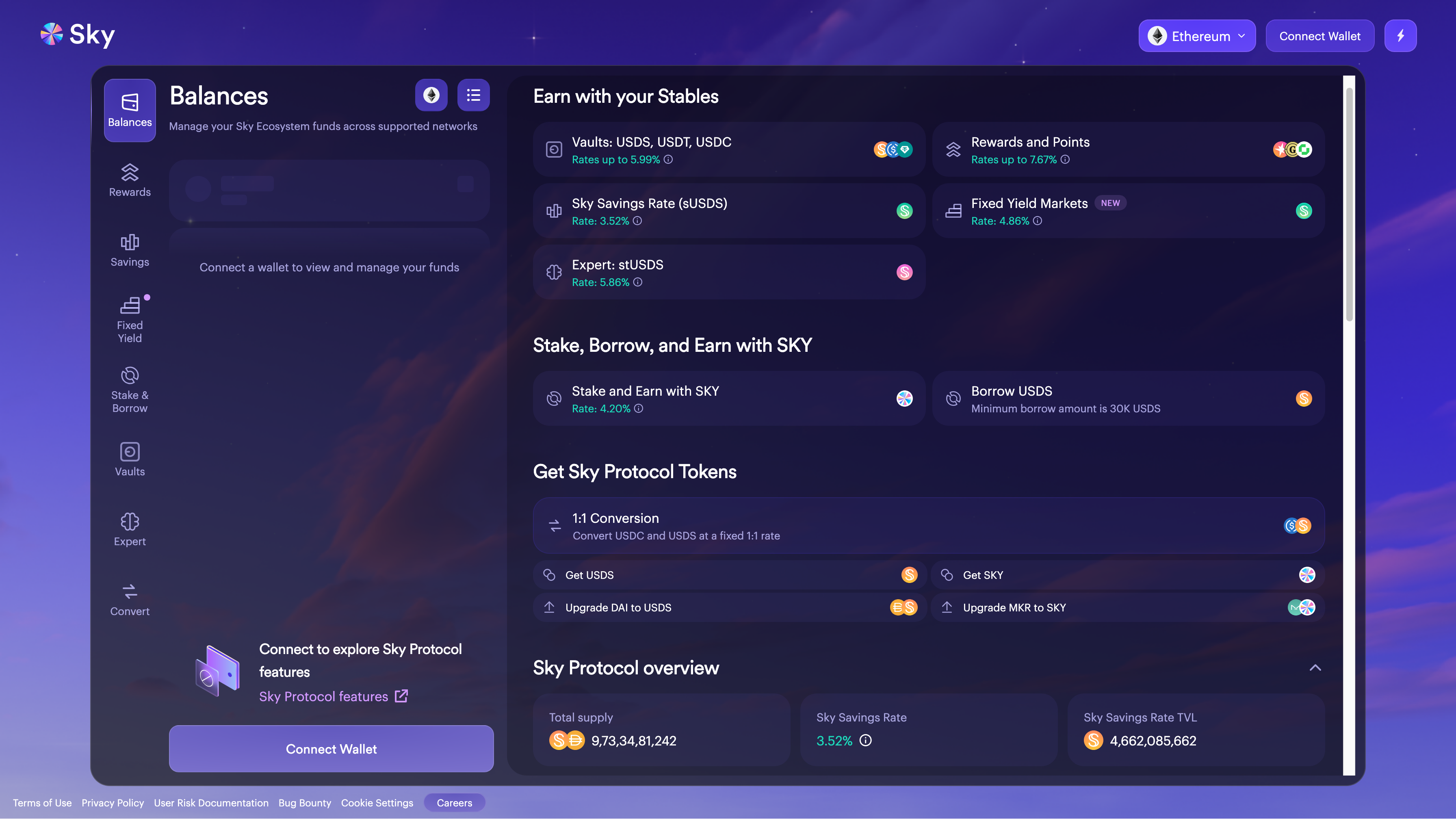
Sky Money's product range has expanded considerably. Users can access the Sky Savings Rate through sUSDS, interact with curated DeFi vaults, stake SKY, and access additional ecosystem reward opportunities. In 2026, Sky Money has also expanded its presence on Morpho through curated lending vaults and introduced additional products involving USDT, USDC, USDS, and fixed-yield strategies.
This article explores what Sky Money is, how it works, its major products, USDS and sUSDS, SKY staking, vaults, benefits, risks, and its potential role in the future of decentralized finance.
Sky Money is a user-facing gateway to products within the broader Sky ecosystem. Its main purpose is to make decentralized savings and yield opportunities more accessible to cryptocurrency users.
Rather than functioning like a conventional bank, Sky Money provides access to blockchain-based financial products. Users interact with smart contracts and decentralized protocols through a compatible cryptocurrency wallet.
The ecosystem is centered around USDS, a stablecoin associated with Sky, and products designed to allow users to generate returns from stablecoin holdings.
Sky Money describes its platform around products including the Sky Savings Rate, curated vaults, and SKY staking. Its current platform also promotes swapping USDC and USDS on a 1:1 basis without a platform fee.
The distinction between Sky Money and the broader Sky protocol is useful. Sky is the underlying decentralized financial ecosystem, while sky.money provides a more accessible interface through which users can interact with several of its products.
To understand Sky Money, it is important to understand its history.
The project developed from MakerDAO, one of the earliest and most established decentralized finance protocols. MakerDAO became well known for DAI, a decentralized stablecoin designed to maintain a value close to the U.S. dollar.
The broader project later went through a major transformation known as the Endgame initiative. As part of this transition, the ecosystem introduced the Sky brand, with USDS becoming the primary stablecoin associated with the new system and SKY becoming the principal governance token.
This transformation was designed to create a more scalable and modular financial ecosystem.
The result is that Sky Money is not an entirely new DeFi concept created from scratch. Instead, it represents a new interface and product ecosystem built on years of development and experience associated with Maker.
USDS is one of the central assets in the Sky ecosystem. It is designed as a dollar-oriented stablecoin, meaning its value is intended to remain close to one U.S. dollar. Stablecoins are important in DeFi because they provide users with an asset that is less volatile than cryptocurrencies such as ETH or BTC.
Users can therefore use stablecoins for:
1.Savings
2.Trading
3.Lending
4.Borrowing
5.Liquidity provision
6.DeFi strategies
USDS is particularly important to Sky Money because several of the platform's savings and reward products are built around it. However, users should remember that a stablecoin is not the same thing as money held in a traditional insured bank account. Stablecoins carry their own technical, market, governance, collateral, and regulatory risks.
One of Sky Money's most important products is the Sky Savings Rate, commonly accessed through sUSDS. The basic idea is straightforward: users can supply USDS to a savings mechanism and receive a yield generated through the Sky ecosystem. Rather than simply holding a stablecoin in a wallet, users can potentially earn a return on their capital. The Sky Savings Rate is therefore designed to provide a relatively simple entry point into DeFi yield. This approach can appeal to users who want exposure to decentralized finance without actively managing complicated lending positions or trading strategies. However, the savings rate is not necessarily fixed forever. DeFi yields can change according to governance decisions, protocol economics, market conditions, and other factors. Users should always check the current rate and product conditions before depositing funds.
sUSDS represents a savings-oriented form of USDS associated with the Sky ecosystem. The purpose is to allow users to participate in the Sky Savings Rate while holding a tokenized representation of their savings position. This can make the position more composable within DeFi. For example, sUSDS can potentially be used within other DeFi applications where it is supported. That composability is an important characteristic of decentralized finance. Instead of keeping financial products isolated, users can sometimes combine different protocols to create more advanced strategies. However, composability also creates additional risk because interacting with multiple protocols means exposure to multiple smart contracts and systems.
Another important component of the ecosystem is the SKY token. SKY is associated with governance and participation in the Sky ecosystem. Sky Money provides access to SKY staking, allowing eligible users to participate in staking-related ecosystem mechanisms. Staking can give token holders additional utility beyond simply holding the asset. However, SKY is a volatile cryptocurrency. Its market price can rise or fall substantially, meaning staking rewards do not eliminate the possibility of losses. A user can earn additional tokens while still experiencing an overall loss if the market value of the underlying asset falls significantly. Therefore, token staking should not automatically be interpreted as a risk-free source of passive income.
Sky Money has expanded beyond the basic savings product through curated DeFi vaults. These vaults are designed to allocate capital into selected markets according to defined strategies and risk parameters. Sky Money has established a curator presence on Morpho, a decentralized lending protocol. In 2026, it launched several vaults involving USDS, USDT, and USDC. For example, the Sky Money USDS Flagship Vault uses a structured allocation approach. According to the March 2026 announcement, 80% of deposits were allocated toward the Sky Savings Rate while 20% was allocated across selected Morpho lending markets, subject to exposure limits. This illustrates how Sky Money is moving toward a broader yield-management platform rather than focusing only on a single savings product.
Morpho is an important part of Sky Money's recent expansion. Sky Money acts as a curator for certain Morpho vaults, helping determine how deposited capital is allocated across supported lending markets. According to DeFiLlama's current classification, Sky Money operates as a Morpho vault curator, with tracked assets representing deposits in vaults curated by Sky. This arrangement can give users access to more sophisticated lending strategies while still providing a relatively simple interface. However, users should recognize that a curated vault does not remove risk. It introduces additional layers involving the vault strategy, underlying lending markets, smart contracts, collateral, oracles, and broader DeFi conditions.
Sky Money has expanded its stablecoin offerings beyond USDS. In February 2026, Sky Money announced USDC and USDT Risk Capital Vaults associated with stUSDS-collateralized Morpho markets. In March, it announced a USDT Savings Vault and a USDS Flagship Vault. The USDT Savings Vault was designed to deploy USDT into an existing sUSDS/USDT Morpho market, while the USDS Flagship Vault combined Sky Savings Rate exposure with selected lending markets. These developments show how the platform is attempting to attract different categories of stablecoin liquidity. For users, the advantage is greater choice. Instead of being limited to one stablecoin strategy, they can potentially choose products according to their desired risk and return profile.
Another development within Sky Money is fixed-yield functionality. In 2026, Sky Money partnered with Pendle to make fixed-yield products accessible through its interface. Pendle reported that the new products reached approximately $40 million in deployed capital during their early period. Fixed-yield products can be attractive because they offer greater certainty about the expected return over a defined period. This differs from variable-rate DeFi products, where yields can change as market conditions evolve. However, fixed yield does not mean zero risk. Users remain exposed to smart-contract, protocol, liquidity, market, and counterparty-related risks depending on the specific structure.
Sky Money has also introduced ecosystem reward programs. These programs can allow users to supply USDS and earn additional rewards associated with projects participating in the Sky ecosystem. For example, Sky Money has promoted Ecosystem Rewards programs involving external projects and their tokens. Current platform information shows that these opportunities can provide additional incentives beyond the underlying stablecoin yield. Such rewards can make products more attractive, but users should carefully examine where the additional yield originates. A high advertised APY may partly consist of token incentives rather than sustainable economic revenue.
Stablecoin-Focused Products
One of Sky Money's main advantages is its focus on stablecoin-based financial products.
Users who want to reduce exposure to the volatility of assets such as BTC and ETH may find stablecoin strategies easier to understand.
Non-Custodial DeFi
Sky Money operates through blockchain-based infrastructure, allowing users to interact with DeFi products without relying on a traditional bank to hold their assets.
Multiple Yield Options
The platform offers several approaches, including savings, vaults, staking, and additional reward opportunities.
Established Ecosystem
The underlying Sky ecosystem evolved from MakerDAO, which gives the project a long operating history compared with many newer DeFi protocols.
Integration With Other Protocols
Morpho and Pendle integrations demonstrate how Sky Money is using DeFi composability to expand its product range.
Risks of Sky Money
No DeFi platform is completely risk-free.
Smart Contract Risk
Sky Money and its connected protocols depend on smart contracts. Software vulnerabilities can result in financial losses.
Stablecoin Risk
USDS is designed to maintain dollar-oriented value, but stablecoins can experience periods of stress or deviation from their intended price.
Governance Risk
Decentralized protocols depend on governance systems. Decisions made by token holders or governance participants can affect protocol parameters, products, and risk.
Vault Risk
Curated vaults can introduce additional risks because capital may be deployed across external lending markets.
Market Risk
SKY and other crypto assets can experience substantial price volatility.
Yield Risk
Advertised yields can change. Incentive programs can end, lending demand can fall, and governance decisions can modify savings rates.
Regulatory Risk
DeFi and stablecoins are subject to an evolving regulatory environment. Rules can vary substantially between countries.
Sky Money is an important part of the evolving Sky DeFi ecosystem. Built around USDS and a range of yield-generating products, it gives cryptocurrency users access to decentralized savings, staking, vaults, and other financial strategies.
The Sky Savings Rate and sUSDS provide a relatively straightforward way to put stablecoins to work, while SKY staking offers another form of ecosystem participation. More advanced users can explore curated Morpho vaults, fixed-yield products, and ecosystem reward programs.
The platform's connection to the long-running MakerDAO ecosystem provides a significant historical foundation, but users should not confuse longevity with the absence of risk. Smart contracts, stablecoins, governance, market volatility, vault strategies, and regulatory changes can all affect outcomes.
Ultimately, Sky Money represents a broader movement in DeFi: transforming stablecoins from passive digital dollars into programmable financial assets that can generate yield and participate across decentralized markets.
As Sky continues expanding its products and integrations, Sky Money could become an increasingly important gateway between ordinary cryptocurrency users and the more sophisticated world of decentralized financial infrastructure.

Made with Mobirise
Web Page Creator